Major tax audits often pose a serious challenge for businesses, particularly companies with government contracts and turnover in the billions of roubles.
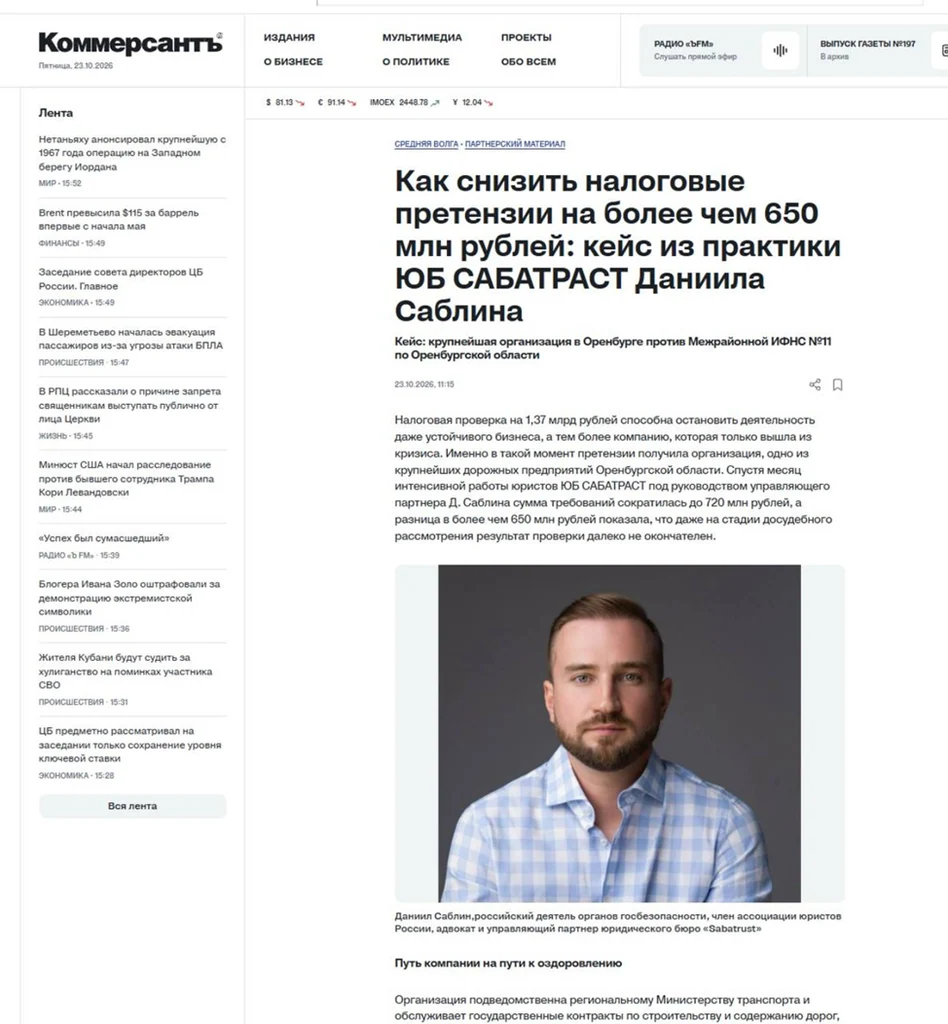
This was the situation faced by Orenburgremdorstroy JSC, one of the region’s largest road construction companies. Following an on-site audit, the tax authority raised claims of RUB 1.37 billion against the company.
For the business, this meant a substantial financial burden and risks to its continued operations.
Defence strategy
SABATRUST’s lawyers joined the matter at the stage when the audit findings were being considered. They developed a comprehensive strategy involving:
– a detailed analysis of financial and business transactions
– a review of case law in similar disputes
– the preparation and refinement of objections
– active procedural engagement with the tax authority
Working with evidence became the central focus.
An extensive body of evidence
The team coordinated with the company’s branches across the region and with contractors.
The evidence collected included:
– additional documents
– geolocated photographs and video footage
– confirmation that the work had actually been performed
This made it possible to establish the true circumstances of the business transactions.
Reconstructing the tax position
A key tool was tax reconstruction: recalculating liabilities to reflect the actual circumstances.
Following a series of discussions with the tax authority, the parties agreed on a calculation model reflecting the actual work completed and the contractors’ costs.
Outcome
- Initial additional assessments: RUB 1.37 billion
- After review: RUB 745 million
- Result: a reduction of more than RUB 625 million
Why this case matters
– many tax disputes can be resolved before they reach court
– proving that transactions genuinely took place is decisive
– tax reconstruction is an effective defence tool
– systematic work with documents can significantly change the tax authority’s position
Expert conclusion
In major tax disputes, legal arguments alone are not enough: it is also essential to demonstrate the economic substance of transactions and prove that the work was actually performed.
Conclusion
Even assessments running into billions can be reconsidered when the defence combines strategy, analysis and evidence.
If your business faces claims from the tax authorities, it is important to begin preparing your defence as early as possible.
How the lawyers at Sabatrust reduced tax claims against Orenburgremdorstroy JSC by more than RUB 625 million
Major tax audits rarely end quickly or painlessly, especially where a company has turnover in the billions and government contracts. In one such dispute, our lawyers secured a significant revision of the tax authority’s demands and reduced the claims by more than RUB 625 million.
When a tax audit becomes a critical risk
Orenburgremdorstroy JSC is one of the largest road construction companies in the Orenburg Region and operates under the regional Ministry of Transport. The company performs government contracts for road construction and maintenance, with annual turnover of approximately RUB 18 billion.
Shortly before the tax dispute, the company had gone through a difficult period. Following a change of management, the new general director, Pavel Yurchenko, had to rebuild the company’s management system and restore its financial health.
During its first nine months, the new team stabilised the company’s finances: it generated profit exceeding RUB 1 billion, repaid part of its accumulated liabilities and stopped taking on new loans.
At the same time, however, the company faced a serious challenge arising from an on-site tax audit. Following the audit, Interdistrict Inspectorate No. 11 of Russia’s Federal Tax Service for the Orenburg Region concluded that the company had understated its tax liabilities and raised claims of RUB 1.37 billion. For a company delivering government infrastructure contracts, assessments of this size could create a serious financial burden.
Defence strategy
The first stage involved a preliminary review of the company’s documents and information, together with an analysis of case law in similar disputes from 2022 to 2025. This informed the defence strategy and procedural approach. The company’s representatives attended the consideration of the audit materials on 24 December 2025, submitting applications to extend the review period, which provided additional time to gather evidence, to take mitigating circumstances into account, and to inspect the case file. Initial objections to the audit report were submitted but later withdrawn, by agreement with the tax authority, for further development.
The project involved a comprehensive defence strategy. The lawyers analysed the company’s financial and business transactions, reviewed case law in similar tax disputes and prepared objections to the audit report. In parallel, they organised the collection of evidence showing that the disputed transactions were genuine. Particular attention was paid to dealings with contractors, which had been the original focus of the tax authority’s claims.
Working with evidence
A crucial stage was gathering evidence that subcontractors had actually performed the work. Extensive coordination took place with the company’s departments and contractors, including 24 road management divisions of Orenburgremdorstroy JSC across the region. Additional documents and information were requested and obtained from contractors, including photographs and videos with geolocation data and metadata confirming work on specific road sections. Staff from the company’s road divisions helped identify the sections concerned and confirmed that contractual obligations had been fulfilled. In January 2026, team members worked at Orenburgremdorstroy’s office in Orenburg, holding meetings, providing explanations and coordinating document collection, spending approximately 110 hours on site in total. This work established the actual circumstances of the transactions and produced the evidence underpinning the legal position.
Reconstructing the tax position
Tax reconstruction became the key defence tool: a mechanism for determining a taxpayer’s actual liabilities in light of the true circumstances of its business transactions.
Our firm proposed several models for calculating the tax liabilities. Following a series of working discussions with the tax authority, a reconstruction model was agreed that reflected the actual volume of work and contractors’ costs, based on photographic reports from the road divisions and verified subcontractor data. On 27 January 2026, partial objections were submitted with 1,416 pages of supporting documents. On 29 and 30 January, revised objections totalling 96 pages were submitted, together with electronic media containing 456 supporting files and an application to reduce the penalties. This approach made it possible to substantially revise the audit’s initial findings.
Outcome of the dispute
The final consideration of the audit materials took place on 30 January 2026. In its decision, the tax authority revised its initial findings in light of the arguments and supporting documents submitted.
The tax claims were significantly reduced: the initial demands amounted to RUB 1.37 billion, falling to RUB 745 million after the objections were considered. This reduced the additional tax assessments by more than RUB 625 million!
For Orenburgremdorstroy JSC, the decision preserved working capital and enabled continued stable performance of its government contracts. Preserving the business also helped the state retain a taxpayer and protect social stability and the region’s infrastructure.
Why this case matters for businesses
Disputes of this kind show that tax audit findings are not necessarily final. With effective legal work, even substantial additional assessments can be reconsidered.
This case highlights several important lessons for businesses:
- many tax disputes are resolved during the consideration of audit materials, before court proceedings;
- proving that business transactions genuinely took place is crucial;
- tax reconstruction is becoming one of the most effective tools for protecting taxpayers;
- systematic work with documents and the underlying facts can often substantially reduce the tax authority’s claims.
Expert view: commentary from Managing Partner of Sabatrust Daniil Sablin:
Experience shows, that in major tax disputes, the decisive factor is not only legal argument but also the ability to build a complete evidential account of the business transactions.
Tax authorities increasingly examine actual business processes, cash flows and the work performed. Protecting a taxpayer therefore requires more than formal objections: it calls for in-depth analysis, including reconstruction of the transactions and evidence of their economic substance.
Consistent work is essential at every stage, from analysing the audit findings to discussions with the tax authority and presenting evidence. This comprehensive approach can substantially change the initial findings and lead to a more objective determination of tax liabilities.
The Orenburgremdorstroy case shows that even assessments in the billions can be revised when the defence combines a legal strategy, detailed work with evidence and effective engagement with the tax authorities.
Need help with a tax dispute?
SABATRUST has a successful track record in complex tax matters. If your business faces claims from the Federal Tax Service, we can analyse the situation and develop an effective defence strategy. Contact us to discuss your case, assess the prospects and help preserve your company’s financial stability.